
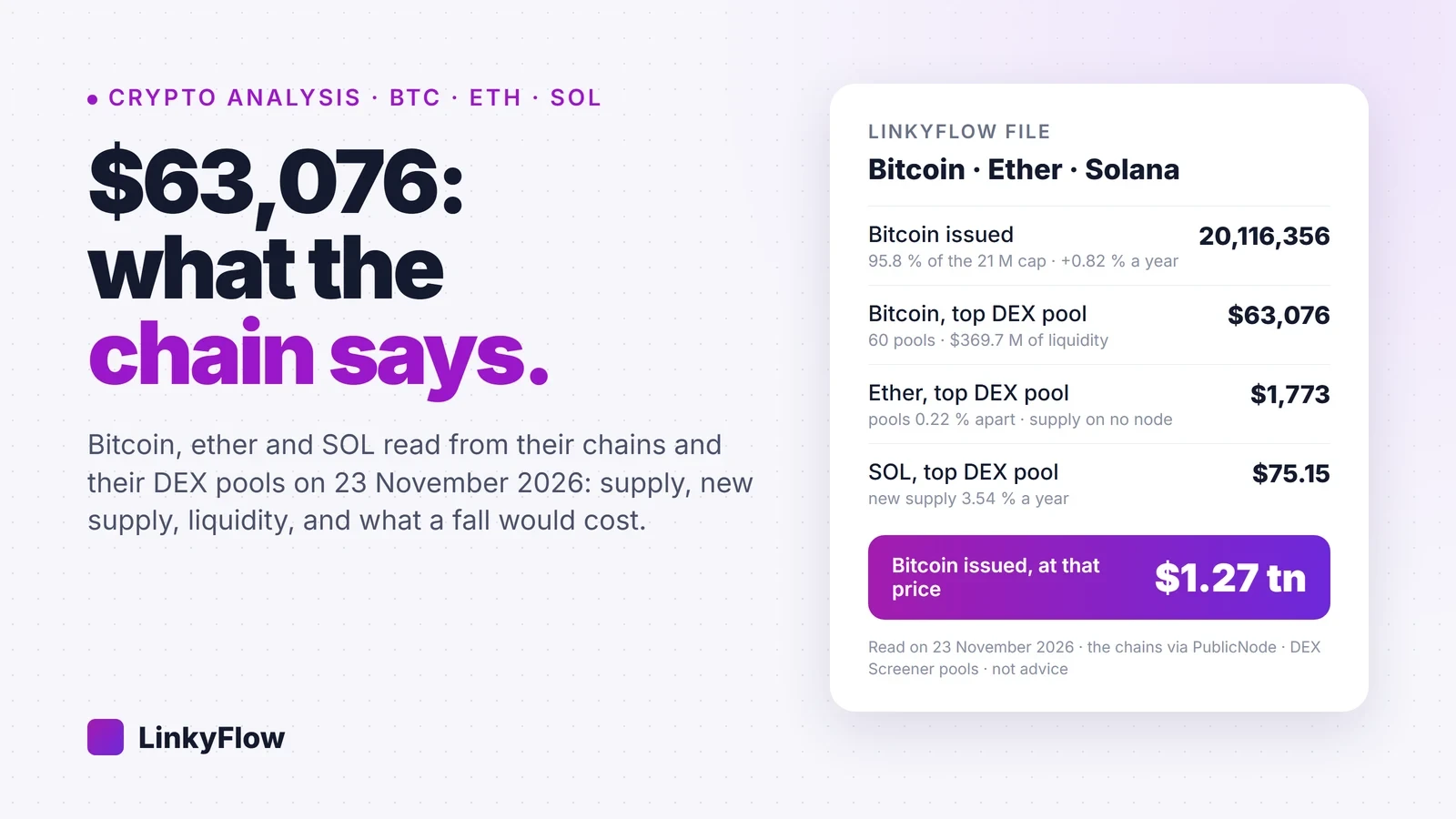
Bitcoin at $63,076, ether at $1,773, SOL at $75.15: what their chains say
Bitcoin is near $63,000: Fortune's daily tracker had it at $64,146 on 18 November, and on 23 November its most liquid pool on a decentralised exchange priced it at $63,075.87. Before buying the dip, or selling it, it is worth reading what does not depend on anyone's opinion: how many coins exist, how many are added each year, how much money stands behind the price, and what a fall would cost you.
This article reads bitcoin, ether and SOL with LinkyFlow in ChatGPT or Claude, the way we read NVIDIA's filings. Every figure below was read on 23 November 2026 at 16:19 UTC, from the chains themselves and from their pools on decentralised exchanges. It is an analysis of public data, not investment advice.
In short
- Bitcoin: 20,116,356 coins issued at block 977,233, 95.79 % of the 21 million that will ever exist; 0.816 % of new supply a year. At $63,075.87, the coins issued are worth $1.27 trillion.
- Ether: the deepest pools of the three ($71.6 million in its top pool, pools 0.22 % apart), but no node states how much ether exists. Given the 122.2 million The Block reported, its market cap is $216.7 billion.
- SOL: 3.544 % of new supply a year, read from the chain; the busiest pools (815,671 trades in 24 hours, volume 2.6 times their liquidity). Given BingX's 592.0 million in circulation, its market cap is $44.5 billion.
- What a fall costs: on $1,000, −50 % leaves $500, −80 % leaves $200, −95 % leaves $50 — and bitcoin at −80 % would be a $254-billion asset, ether at −80 % $354.59.
Step 1 — Ask in one sentence
In ChatGPT or Claude, with LinkyFlow added (Add LinkyFlow to ChatGPT), type:
Analyse bitcoin with crypto_analyze.
Name a coin by its name — bitcoin, ethereum, solana, binancecoin — and a token by its chain and contract address. A symbol alone is refused: thousands of tokens call themselves "ETH" or "USDC", and LinkyFlow says so when one does.
What LinkyFlow reads. Two sources, because only two allow a paid service to show what it derives from them: the chains themselves, through PublicNode's public nodes, and the pools of decentralised exchanges, through DEX Screener. It reads no centralised exchange and no price aggregator: Binance, Kraken, Coinbase, CoinGecko or DefiLlama all reserve that use to a paid licence or a written agreement. So two things are yours to give, if you want them: the price you see on your exchange, and its daily closes for volatility, drawdown or moving averages. LinkyFlow uses them and says they are yours.
The price is a pool's. On a decentralised exchange, bitcoin trades as tokens that stand for it — WBTC and cbBTC, backed by bitcoin their custodians hold — and ether as WETH. LinkyFlow takes the price of the most liquid pool, says which one, and measures how far the other pools disagree. It never averages pools that disagree, and it leaves out a pool whose price contradicts the others: that afternoon, two pools priced the memecoin BONK at 4,300 times its price everywhere else, with $26 million of "liquidity" computed from that price.
Step 2 — Bitcoin: a supply you can count
| Bitcoin | |
|---|---|
| Coins issued | 20,116,356.25 BTC at block 977,233 |
| Share of the 21 million cap | 95.79 % |
| New supply | 3.125 BTC a block, 0.816 % a year |
| Price | $63,075.87, a WBTC pool on Curve holding $67.6 million |
| Pools | 60, holding $369.7 million |
| Spread between pools | 2.27 % |
| Volume, 24 hours | $128.8 million; 8,983 buys, 8,656 sales |
| Value of the coins issued | $1.27 trillion |
| Value of 21 million coins | $1.32 trillion, 4.39 % more |
Source: the Bitcoin chain through PublicNode (the last block), DEX Screener (the pools of WBTC and cbBTC), read by LinkyFlow on 23 November 2026.
Bitcoin's supply is the one figure that needs no source at all: the protocol pays 50 bitcoins a block, halved every 210,000 blocks, so the coins issued are the sum of that schedule up to the last block. LinkyFlow counts them from the block height. It is an upper bound: coins lost since 2009 are counted too.
The 2.27 % spread is worth reading. The deepest pools of WBTC and cbBTC did not agree on bitcoin's price that afternoon: up to $1,430 apart. The price you get depends on which token, and which pool, you trade.
Step 3 — Ether: the deepest pools, and a supply no node states
| Ether | |
|---|---|
| Price | $1,772.93, WETH/USDC on Uniswap v3, holding $71.6 million |
| Pools | 30, holding $271.6 million |
| Spread between pools | 0.22 % |
| Volume, 24 hours | $239.2 million, 0.88 times the liquidity |
| Supply | not stated by any node — 122.2 million given, as The Block reported it on 22 November |
| Market cap | $216.7 billion, with that supply |
Ether has the deepest and most consistent pools of the three: its top pool alone holds more than bitcoin's, and its pools agree within 0.22 %. But ether has no cap, and part of every transaction's fee is burnt, so its supply is a sum over every block since 2015 that no node answers. LinkyFlow does not estimate it: it says it is unknown and asks for it. Given one, it computes the market cap and says whose figure it is.
For the same reason, LinkyFlow gives ether no overall score: the supply axis cannot be measured, and an overall score needs three axes. That is the rule, not a gap: a score built on what could not be read would look precise and mean nothing.
Step 4 — SOL: 3.5 % new supply, the busiest pools
| SOL | |
|---|---|
| Price | $75.15, SOL/USDC on Orca, holding $17.9 million |
| Pools | 30, holding $61.6 million |
| Spread between pools | 0.67 % |
| Volume, 24 hours | $162.6 million, 2.64 times the liquidity; 401,003 buys, 414,668 sales |
| New supply | 3.544 % a year (Solana's inflation rate, epoch 1094) |
| Supply | 592.0 million in circulation given, as BingX showed it on 23 November |
| Market cap | $44.5 billion, with that supply |
SOL's pools are the busiest by far: more than 800,000 trades a day, its volume more than twice its liquidity. They are also the shallowest of the three: $17.9 million in the top pool, a quarter of ether's. And SOL's supply grows by 3.5 % a year, which a holder who does not stake pays for in dilution. The Solana node LinkyFlow reads gives the inflation rate; it gives the supply only with a personal token, which LinkyFlow does not use.
Step 5 — Side by side
| Bitcoin | Ether | SOL | |
|---|---|---|---|
| Price (top DEX pool) | $63,075.87 | $1,772.93 | $75.15 |
| Top pool | $67.6 M | $71.6 M | $17.9 M |
| All pools | $369.7 M | $271.6 M | $61.6 M |
| Spread between pools | 2.27 % | 0.22 % | 0.67 % |
| New supply a year | 0.816 % | not read | 3.544 % |
| Supply | from the chain | given | given |
| Market cap | $1.27 tn | $216.7 bn | $44.5 bn |
| Score | 81 | not scored | 80 |
| Risk | medium | unrated | medium |
The score places each measured factor on a stated scale: liquidity (the top pool's, and the spread), supply (new supply, the share of the cap issued, the dilution to it), and how much of the analysis rests on figures read rather than missing. Bitcoin's spread costs it on liquidity (77.3) and its schedule earns it 94.4 on supply; SOL's inflation brings its supply axis to 64.6.
Why "medium", not "low". A coin's swings are most of its risk, and swings need daily closes, which no free source allows LinkyFlow to show. Without them the market axis is left unmeasured, and LinkyFlow never calls the risk low. Give your exchange's daily closes and the analysis adds returns over 7, 30, 90 and 365 days, the annualised volatility, the largest fall of the year, the moving averages and the RSI, each computed on a 365-day calendar.
Step 6 — What a fall would cost
LinkyFlow computes moves, not forecasts: the price after each one, the market cap it implies, and what a $1,000 position becomes.
| Move | Bitcoin | Ether | SOL | $1,000 becomes |
|---|---|---|---|---|
| −50 % | $31,537.94 (cap $634 bn) | $886.47 | $37.58 | $500 |
| −80 % | $12,615.17 (cap $254 bn) | $354.59 | $15.03 | $200 |
| −95 % | $3,153.79 (cap $63 bn) | $88.65 | $3.76 | $50 |
| +100 % | $126,151.74 (cap $2.54 tn) | $3,545.86 | $150.30 | $2,000 |
Read the market cap a move implies before the price. Bitcoin doubling from here means $2.54 trillion of bitcoin; at −95 %, $63 billion, not much more than SOL's $44.5 billion today. Neither is a prediction: they are the arithmetic that says what each scenario requires.
And a memecoin?
Bitcoin, ether and SOL have no contract to inspect. A token does, and its contract can give whoever controls it the power to mint more, to block a holder, or to tax a sale until no sale is possible. Ask:
Check the security of 0x6982508145454Ce325dDbE47a25d4ec3d2311933 on Ethereum with crypto_analyze_token_security.
For PEPE, that afternoon: ownership renounced, no mint, blacklist, tax, pause or trading switch in its code, $24.0 million in its top pool, a first pool 1,319 days old, 854 buys and 839 sales in 24 hours. Level low, score 85. A token launched twelve minutes earlier on pump.fun scored 55, level high: no history, and no liquidity stated on its launch curve.
Why 85 and not 100? Three things are never read, and the report says so every time: a sale is not simulated, the holders are not listed, and whether the pool's liquidity is locked is not verified. The services that check them do not allow a paid service to use their data. An unknown is never a pass, so no token is ever called safe.
How LinkyFlow does it
- Sources: the chains through PublicNode's public nodes (a contract's own answers, a Solana mint's authorities, the last Bitcoin block, Solana's inflation) and DEX Screener's pools. Each was read only once its terms allowed a paid service to show what it derives from them.
- Rules: a price is one pool's, never an average; a mispriced pool is left out with its liquidity; a figure a source does not give is absent, never 0; a market cap and a fully diluted value are compared only on one basis.
- No model: LinkyFlow computes, your assistant writes. What could not be read is listed as unknown.
- The dossier: each analysis is kept for 90 days by the Crypto Analysis Agent if your plan includes an agent. Run it again later on the chain and the pools as they are then. It never connects a wallet and never trades.
What this analysis is not
Not advice to buy, hold or sell, and not a price forecast. The moves are assumed, not expected. The supplies of ether and SOL are the figures given, with their source. A coin's chain says what exists and what is added; its price says what buyers expect, and that can change by half in a month.