
Choose your shop's location with public data, before you sign the lease
A standard French commercial lease (3-6-9) commits you for at least three years: at €3,000 of rent a month, that is €108,000 signed before you have sold a single item. Yet the street is often chosen on one visit, one Saturday afternoon. Public data says far more, and before you sign:
- who lives around, and on what income;
- how many travellers use the nearby station;
- how many shops of your trade are already there;
- whether the local plan protects the street as a shopping street;
- how many businesses in the town were sold or went into liquidation this year.
This article compares three candidate premises for a clothing brand that already sells online and wants a shop in the Paris region: rue Paul Vaillant-Couturier in Argenteuil, rue de Bezons in Courbevoie, rue de la Roquette in Paris 11th. The brand is an example; the data is real. LinkyFlow read it on 22 November 2026, and your assistant (ChatGPT or Claude) presents it. It is not advice.
In short
- Start from your customers. Shopify orders carry the delivery city and postcode. In LinkyFlow, on the web or in Excel, you see within minutes the towns you already sell to. Those addresses stay in your table: LinkyFlow never sends them to ChatGPT.
- Then compare the addresses on seven public criteria: population and income, stations and transport, competitors, the zoning plan's shopping frontage, business sales and liquidations, homes being built, risks.
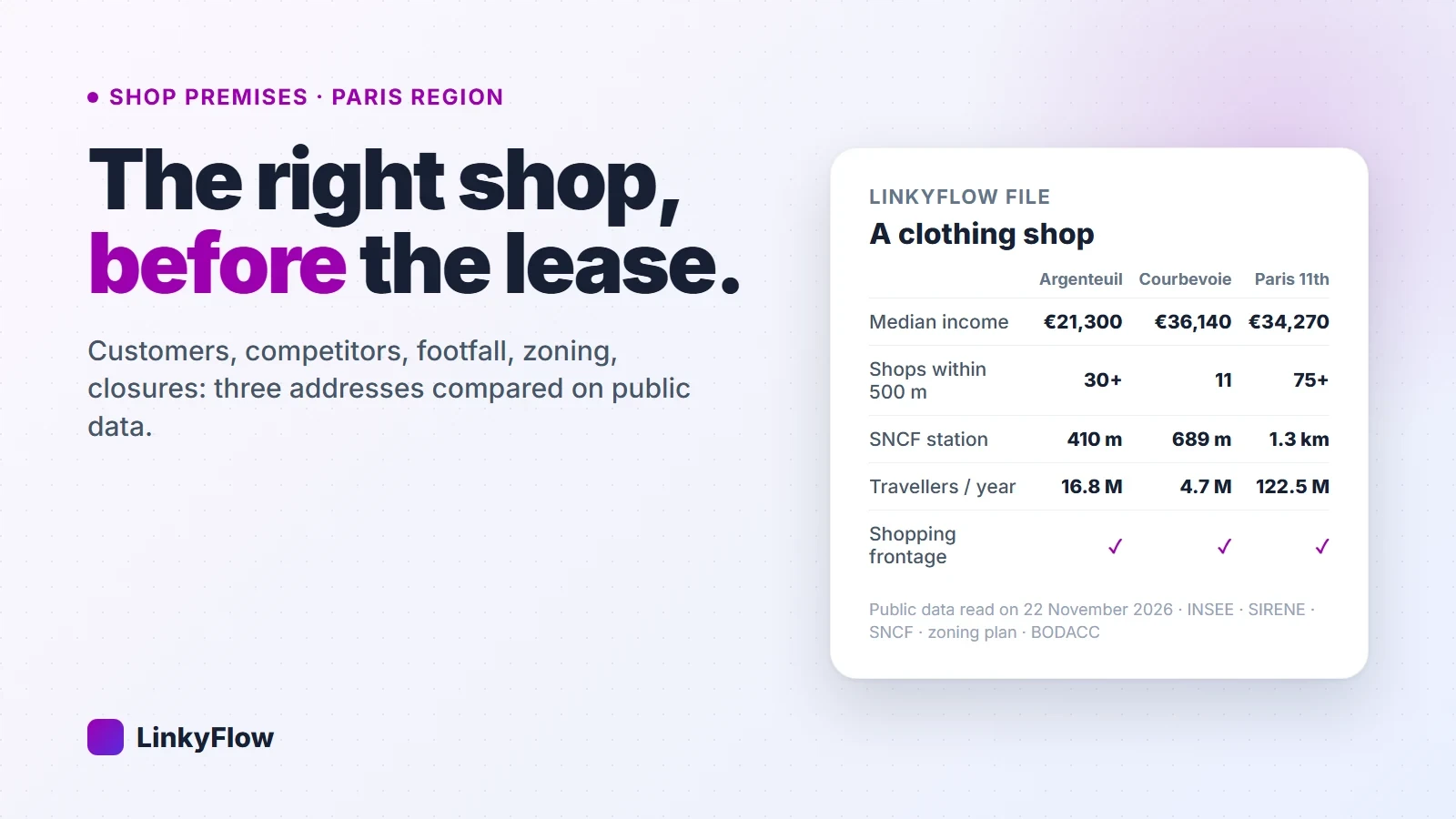
- On our three premises, median income runs from €21,300 (Argenteuil) to €36,140 a year (Courbevoie). Active clothing shops within 500 m run from 11 (rue de Bezons) to 75 (rue de la Roquette). All three streets are protected as shopping streets by their zoning plan.
- No public data gives a street's commercial rent or footfall. LinkyFlow does not invent them: those are the two figures to get from the landlord and from your own count.
1. Start from your customers: where do your orders go?
Your best location signal is already in your online store. Shopify's Order table, loaded in LinkyFlow, includes the delivery address's city and postcode by default. Export it to Excel, then build a pivot table by postcode over the last twelve months: you see where your Paris-region customers cluster, and so where a shop can welcome them.
Those addresses are personal data. They stay in your table: the order tool LinkyFlow gives ChatGPT or Claude passes no customer address.
2. The area: how many residents, on what income?
With LinkyFlow's realestate_lookup tool, source insee, give the population and standard of living of Courbevoie.
| Town | Residents (2023) | Median standard of living (2023) | Poverty rate |
|---|---|---|---|
| Argenteuil | 106,130 | €21,300 a year | 29.8 % |
| Courbevoie | 82,902 | €36,140 a year | 12.1 % |
| Paris 11th | 138,170 | €34,270 a year | 15.6 % |
Source: INSEE (municipal population, Filosofi), for the town or the arrondissement.
For a mid-range or premium brand, Courbevoie and Paris 11th offer spending power close to €35,000 a year per consumption unit. Argenteuil has more residents, but a standard of living about 40 % lower. These are town averages: a town-centre street draws well beyond its residents.
3. Footfall: stations and transport
With realestate_lookup, source stations, which SNCF stations are within 1.5 km of 30 rue Paul Vaillant-Couturier, Argenteuil, and how many travellers use them?
- Argenteuil: Argenteuil station is 410 m away, with 16.8 million travellers in 2025. 20 transport stops are published within 600 m, the nearest 128 m away.
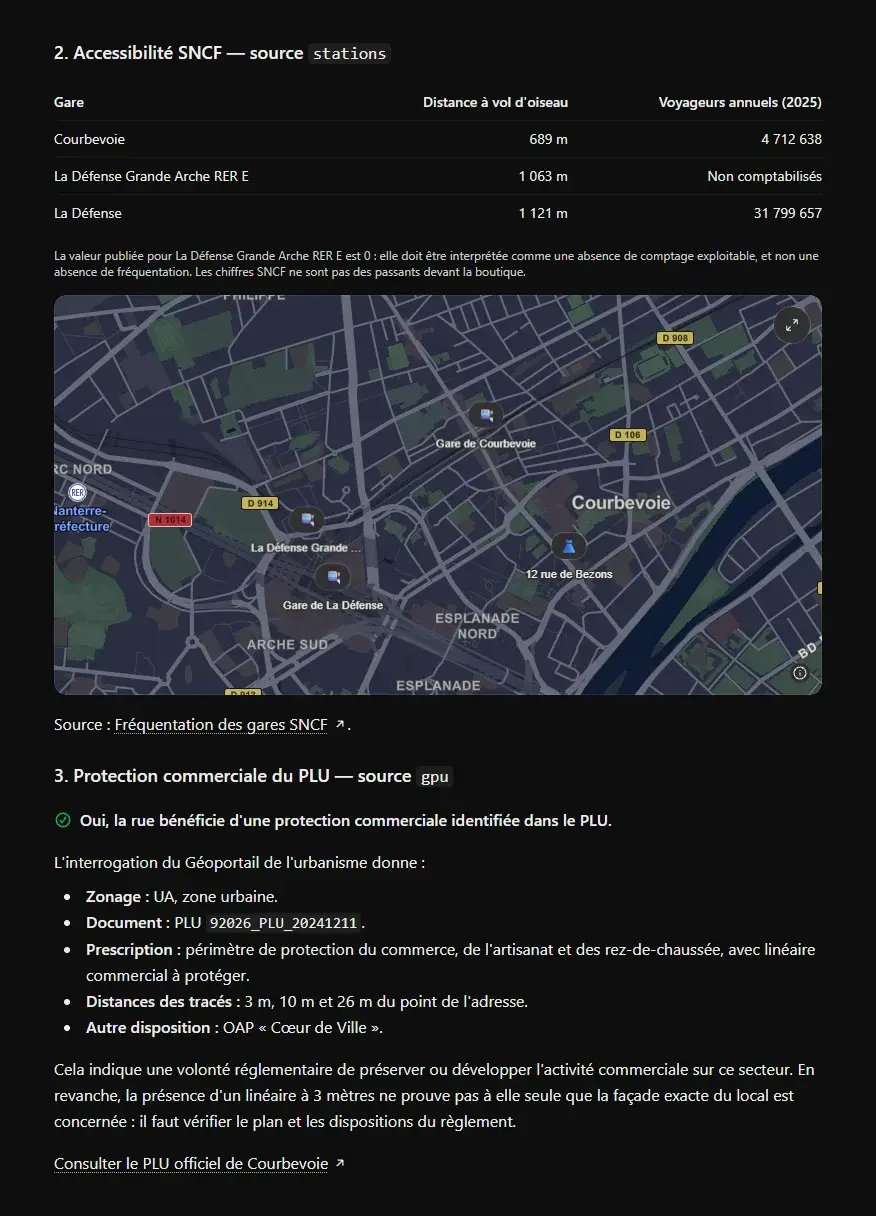
- Courbevoie: Courbevoie station is 689 m away, with 4.7 million travellers, and La Défense 1.1 km away, with 31.8 million. 17 stops are within 600 m, the nearest 55 m away.
- Paris 11th: the nearest SNCF station is Gare de Lyon, 1.3 km away (122.5 million travellers). The metro is not counted in this SNCF data. 60 stops are published within 600 m, the nearest 80 m away.
These figures count travellers at a station, not passers-by at your window. They place an address: 16.8 million travellers 400 m away is not the same street as a 2-million station 1 km away. Footfall at the premises is counted on site, at several hours and on several days.
4. Competitors and neighbouring shops
With realestate_lookup, source establishments, how many clothing shops (NAF 47.71Z) are active within 500 m of 12 rue de Bezons, Courbevoie?
| Premises | Active clothing shops within 500 m |
|---|---|
| Rue Paul Vaillant-Couturier, Argenteuil | at least 30, 4 of them within 75 m |
| Rue de Bezons, Courbevoie | 11, the nearest 59 m away |
| Rue de la Roquette, Paris 11th | at least 75, the nearest 18 m away |
Source: SIRENE, the company search API's geographic search, active establishments. "At least": the search reads the first 100 companies of the activity around the point.
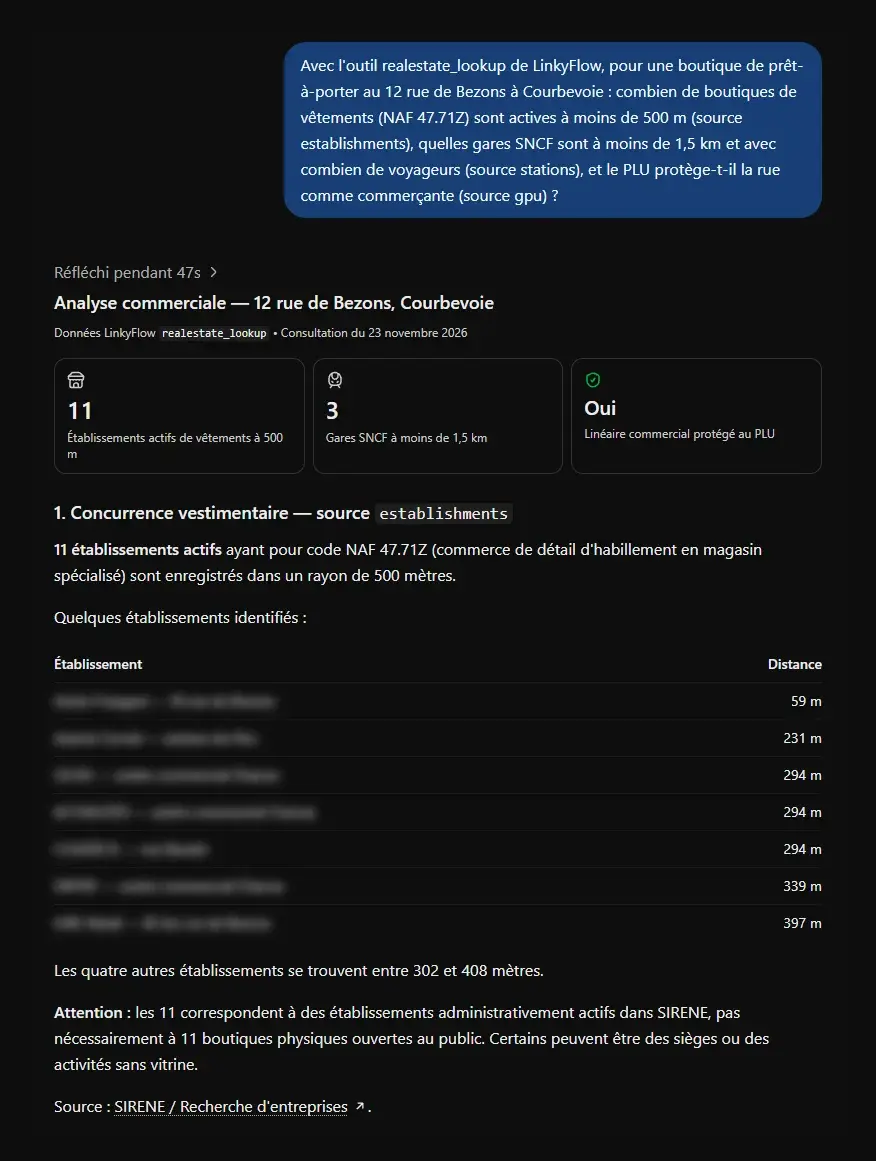
Thirty clothing shops within 500 m is not necessarily bad news: it is a street people come to for clothes, and your shop benefits from the flow. Eleven means less competition, but also a street where you will have to bring customers in. The NAF code counts any trade: a bakery (10.71C), a café (56.30Z), an optician (47.78A).
LinkyFlow gives the figure's limits with it:
- an establishment is a declared address, not a shopfront;
- the activity counted is the one the company declares;
- a shop whose company declares another main activity is not found.
5. Zoning: must the street stay a shopping street?
With realestate_lookup, source gpu, which zoning rules apply to 100 rue de la Roquette, Paris?
All three addresses fall under a retail protection:
- in Argenteuil, a "Linéaire de commerce – type 3" 2 m from the point, in a zone of "wide mix of urban uses" of the Boucle Nord de Seine PLUi;
- in Courbevoie, a "linéaire commercial à protéger" 3 m away;
- on rue de la Roquette, a "street with protection of retail and crafts", 9 m away.
That is good news for a shop. The ground floor must stay commercial, so the street will not lose its shopfronts to housing. It is also a constraint for later: the premises cannot become a home. The zoning rules, which LinkyFlow links to, say what each frontage allows.
6. Business sales and liquidations in the town
With realestate_lookup, source bodacc, which business sales and insolvency proceedings were published in Argenteuil over the last 12 months?
| Town, 22/11/2025 to 22/11/2026 | Sales and transfers | Insolvency proceedings |
|---|---|---|
| Argenteuil | 26 | 312 |
| Courbevoie | 176 | 167 |
| Paris 11th (75011) | 180 | 820 |
Source: BODACC (DILA), commercial announcements of the town.
Read these figures with care, and LinkyFlow says so. Courbevoie's 176 "sales and transfers" include mergers of large groups based at La Défense. The 820 proceedings of the 11th cover all of the arrondissement's businesses, many of them restaurants. Read the announcements one by one: the tool gives the date, the type (purchase of a business, compulsory liquidation…), the activity and the bodacc.fr link.
Above all, check your premises' previous occupant. With its SIREN number (on the sign, an invoice or the transfer notice), the sirene, bodacc and rne sources tell you whether it is still active, whether it was liquidated, and what its latest accounts showed. A premises that has seen three businesses in five years deserves a question to the landlord.
7. The landlord, and what is being built around
If the landlord is a company (an SCI, a property company), the same sources check its identity, officers and legal announcements before you sign.
Homes authorised since 2021, from the Sitadel register, are your future neighbourhood customers:
- Argenteuil: 1,631 homes;
- Courbevoie: 1,390;
- Paris 11th: 360, for the authorisations whose address carries the 75011 postcode.
An authorisation is not a finished building, but it says where the population will grow.
The three premises side by side
| Criterion | Argenteuil | Courbevoie | Paris 11th |
|---|---|---|---|
| Median standard of living | €21,300 | €36,140 | €34,270 |
| Nearest SNCF station | 410 m, 16.8 M travellers | 689 m, 4.7 M travellers (La Défense 1.1 km, 31.8 M) | 1.3 km, 122.5 M travellers (metro not counted) |
| Clothing shops within 500 m | 30 or more | 11 | 75 or more |
| Zoning plan's shopping frontage | yes, 2 m | yes, 3 m | yes, 9 m |
| Insolvency proceedings in 12 months (town) | 312 | 167 | 820 (11th) |
| Homes authorised since 2021 | 1,631 | 1,390 | 360 (11th) |
There is no outright winner:
- Rue de la Roquette is a destination street people come to for clothes, but competition is dense and turnover the highest.
- Rue de Bezons has the best income and the least competition, but less natural flow.
- Argenteuil has the busiest station 400 m away and a growing town, but lower spending power.
The choice depends on your average price and on where your customers already are (step 1). It also depends on the two figures no public register gives: the rent and the footfall at the window.
What LinkyFlow does not do
- No commercial rent: no public data publishes it. Compare the landlords' offers, and the rent per m² of neighbouring premises if you can get it.
- No pedestrian count: SNCF travellers place a neighbourhood; they do not count a street's passers-by, and RATP traffic is not in them.
- No calculated catchment area: LinkyFlow reads the data of an address and a town; it models neither a premises' pull nor its turnover.
- No advice: on the location or the lease. Have the commercial lease (term, permitted use, charges, indexation) reviewed by a professional.
Run the same analysis on your premises
- Add LinkyFlow to ChatGPT or Claude (Add LinkyFlow to ChatGPT). The public data needs no account of yours: your first question adds a "Real estate" connection by itself, with nothing to authorise. Connect your Shopify store for step 1.
- For each candidate premises, ask in order:
insee,stationsandtransport,establishmentswith your trade's NAF code,gpu,bodacc,sitadel. Naming therealestate_lookuptool in the question keeps the assistant from searching the web. - Then ask: "Compare these three addresses in a table, and tell me what none of these sources measures."
FAQ
How do you choose a shop location?
Start from your existing customers (where your orders are delivered), then compare each address on verifiable data: population and income, transport access, competitors in your trade, zoning rules, the town's business health, homes to come. The two figures public registers lack, the rent and the footfall at the window, are negotiated and counted on site.
How do you find the competitors around commercial premises?
The SIRENE register lists active establishments by activity code (NAF) and address. LinkyFlow reads its geographic search: for example, 11 clothing shops (47.71Z) active within 500 m of 12 rue de Bezons, Courbevoie, on 22 November 2026. An establishment is a declared address, not a shopfront: check on site.
How do you know whether a street is protected as a shopping street?
The zoning plan (PLU) shows it with a "linéaire commercial" or a "protection du commerce et de l'artisanat" (prescription code 22 of the CNIG standard). LinkyFlow reads these prescriptions from the Géoportail de l'urbanisme within 30 m of the address, with a link to the rules.
How do you estimate the footfall in front of premises?
No public data counts it street by street. The traffic of nearby SNCF stations (16.8 million travellers a year in Argenteuil, for example) and the number of transport stops place a neighbourhood; footfall at the window is counted on site, on different days and at different hours.
Can you check the landlord or the previous tenant?
Yes, if it is a company: its SIREN is enough to read its identity and status (SIRENE), its legal announcements including insolvency proceedings (BODACC), and its officers and latest published accounts (RNE).
Do you need a paid LinkyFlow plan?
Not for the public data: on the Free plan, its one connection is the "Real estate" connection your first question makes, within 2,000 data lines a month. Adding your Shopify store to map your customers (step 1) makes a second connection, so it takes the Starter plan, which has three.